


The gold standard in calf implants.
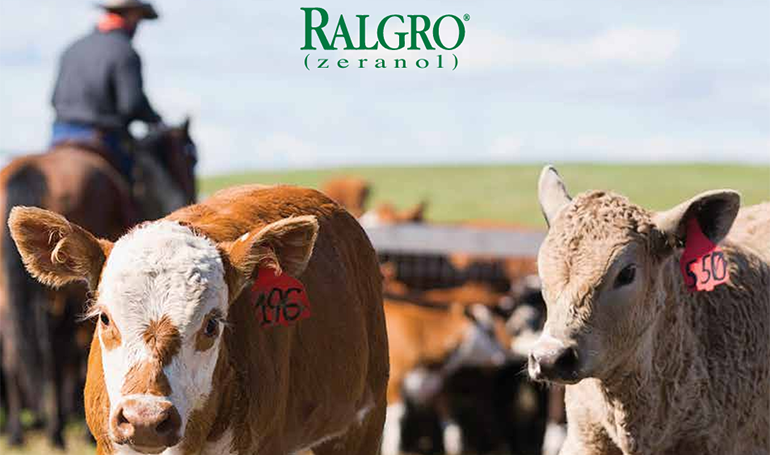
For more than 50 years, RALGRO has been known for heavier weaning weights that deliver greater revenue in calf crops.
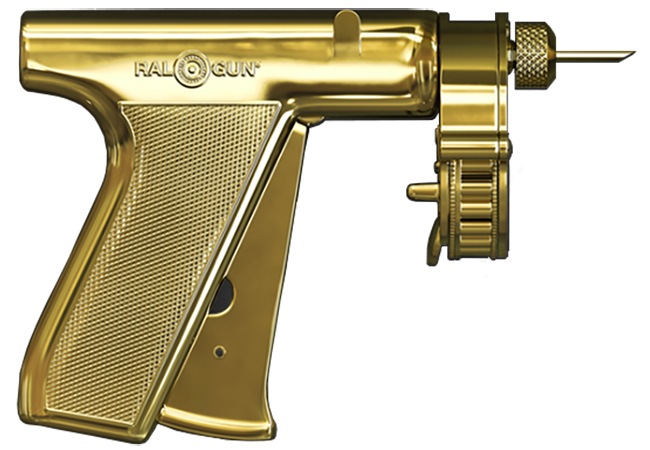
RALGRO provides cow-calf producers implanting ease, flexibility and most important – results.
Product information
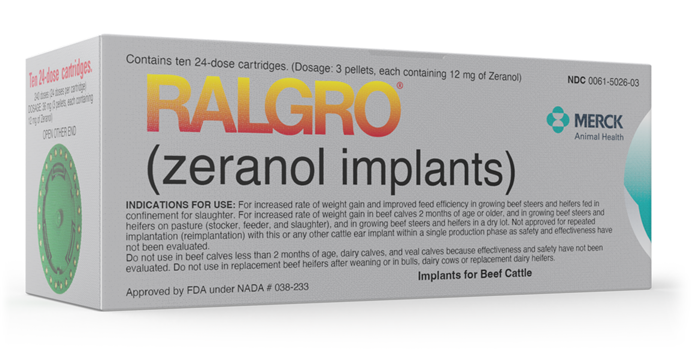
RALGRO®
(zeranol implants)
IMPLANTS FOR BEEF CATTLE
A single pull of the RALOGUN® trigger delivers the proper 36-mg dose (three – 12-mg pellets per chamber).
Indications
RALGRO (zeranol implants) is an anabolic agent that increases rate of weight gain and improves feed efficiency of weaned beef calves, growing beef cattle, feedlot steers, and feedlot heifers. RALGRO also increases rate of weight gain of suckling beef calves.
Key Benefits
Increased weight gain through weaning.
A 23-trial summary showed an average 23-lb. weaning weight advantage (over 163 days) in calves implanted with RALGRO over non-implanted controls.1
The most versatile implant on the market.
With non-sex-specific zeranol as its active component, RALGRO can be used in both male and female calves – even replacement heifers.
Easy to get implanting right.
The ergonomic design of the RALGRO RALOGUN®, combined with a small implant size, reduces fatigue while making it easy to administer pellets accurately.
Other Key Benefits
- Doesn’t affect post-weaning and finishing performance.2
- Reaches effective levels within the first day of administration.3
- No impact on the conception rates of heifers.4
Dosage
USE RALGRO® (zeranol implants) IN CARTRIDGES WITH THE RALOGUN® PELLET INJECTOR
- RALGRO (zeranol implants) is an anabolic agent that increases rate of weight gain and improves feed efficiency of weaned beef calves, growing beef cattle, feedlot steers, and feedlot heifers.
- RALGRO also increases rate of weight gain of suckling beef calves.
- RALGRO pellets each contain 12 mg of zeranol. Three pellets are required for 36-mg dose.
- Dosage is the same for heifers, steers and calves, and replacement heifers.
Supplied
1 cartridge of 24 doses
Ten 24-dose cartridges, 240 doses (24 doses per cartridge)
Storage
RALGRO pellets are stable when stored between 2° and 25° C (36° and 77°F).
Caution
Do not use in bulls intended for reproduction or dairy animals. Do not use before 1 month of age or after weaning in heifers intended for reproduction. Edema of the vulva and udder, teat elongation, rectal and vaginal prolapse, and signs of estrus may occur when heifers are implanted. Delayed testicular development may occur in young males. To avoid difficulty in castration, young males should be castrated at the time of implanting.
Warning
DO NOT ATTEMPT TO SALVAGE IMPLANT SITE FOR HUMAN OR ANIMAL FOOD. IMPLANT PELLETS IN THE EAR ONLY. ANY OTHER LOCATION IS IN VIOLATION OF FEDERAL LAW. A WITHDRAWAL PERIOD HAS NOT BEEN ESTABLISHED FOR THIS PRODUCT IN PRE-RUMINATING CALVES. DO NOT USE IN CALVES TO BE PROCESSED FOR VEAL.
Do not use in veal calves. Effectiveness and animal safety in veal calves have not been established.

Implant today, impact tomorrow.
There is mounting pressure to be more sustainable and many worry they will have to sacrifice their bottom line to do it. See how our growth-promoting implants can help you both achieve sustainability and turn a greater profit.
Proper RALGRO Implanting Technique
Follow these simple steps for a successful implant using the industry-favorite RALGRO RALOGUN.
See the myths. Get the facts.
See all the ways calf implants like RALGRO can help boost margins for cow-calf producers.
Implanting for Performance
Shane Kime believes in taking advantage of all the available tools he can to help put pounds on his cattle. One such tool he swears by? Implants. Especially RALGRO for his calves.
Implant Strategies for Cattle on Grass
RALGRO on the cow, REVALOR-G off the cow. See why that’s the motto Dr. Wade T. Nichols, senior technical services manager, stresses to his clients.
Resources
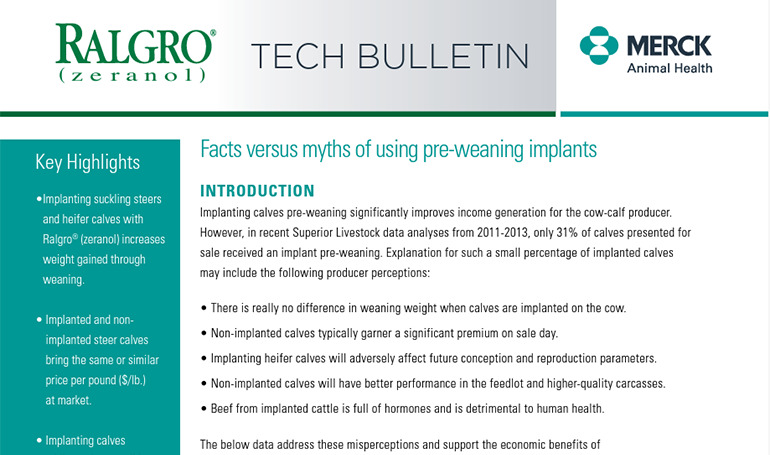
RALGRO – Facts vs. Myths
It’s time to put the misperceptions surrounding pre-weaning implants to rest. This piece shows the clear economic benefit of using RALGRO pre-weaning.
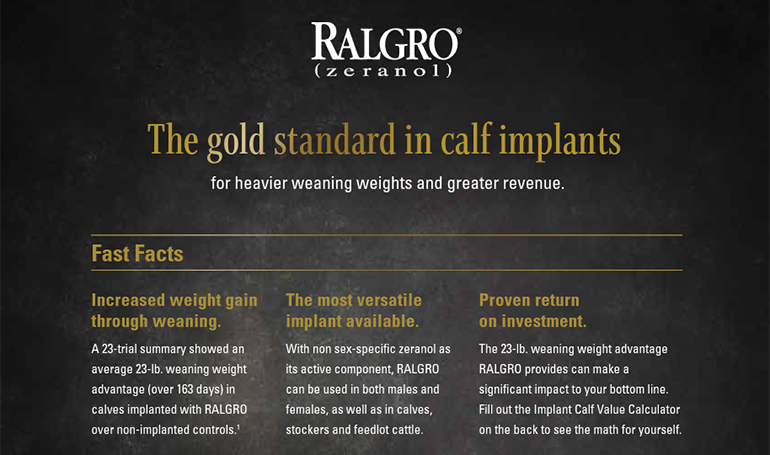
RALGRO Fast Facts
Four reasons why RALGRO continues to be the gold standard in calf implants.
RALGRO Detailer
A comprehensive look at exactly how RALGRO can help strengthen your calf crop.
No items to show.
Contact
U.S. only: Merck Animal Health livestocktechsrvc@merck-animal-health.com or call 1-800-211-3573
For more information regarding efficacy and safety data, go to productdata.aphis.usda.gov
For additional information, please see the product label.
References
1. Data on file, Merck Animal Health.
2. Laudert, et al. 1981.
3. Pusateri AE, Kenison DC. Measurement of zeranol in plasma from three blood vessels in steers implanted with zeranol. J. Anim. Sci. 1993; 71(2):415-419.
4. Data on file, Merck Animal Health.
5. Selk, G. (1997) Implants for Suckling Steer and Heifer Calves and Potential Replacement Heifers. Proceedings: Impact of Implants on Performance and Carcass Value of Beef Cattle. Oklahoma State University, P-957. Pg 40.4. Superior Livestock Sale data report 2018.

Take a look at the other implant options available from Merck Animal Health.
Sign up! Receive cattle health management insights, industry news and more straight to your inbox.